
Quick answer
A useful apparel RFQ is one controlled decision brief: one tech-pack revision, one quantity and delivery context, and one set of questions for every supplier. It makes omissions visible before a low headline price turns into material surcharges, repeated samples, or a different product than the one you intended.
What to send with every clothing manufacturer RFQ
Keep the technical definition and the commercial request separate but bundled. The tech pack defines the garment. The RFQ cover sheet defines the order you want quoted. If either changes, update the version or request date so the supplier can see which assumptions are still current.
Document 01
Reviewed tech pack
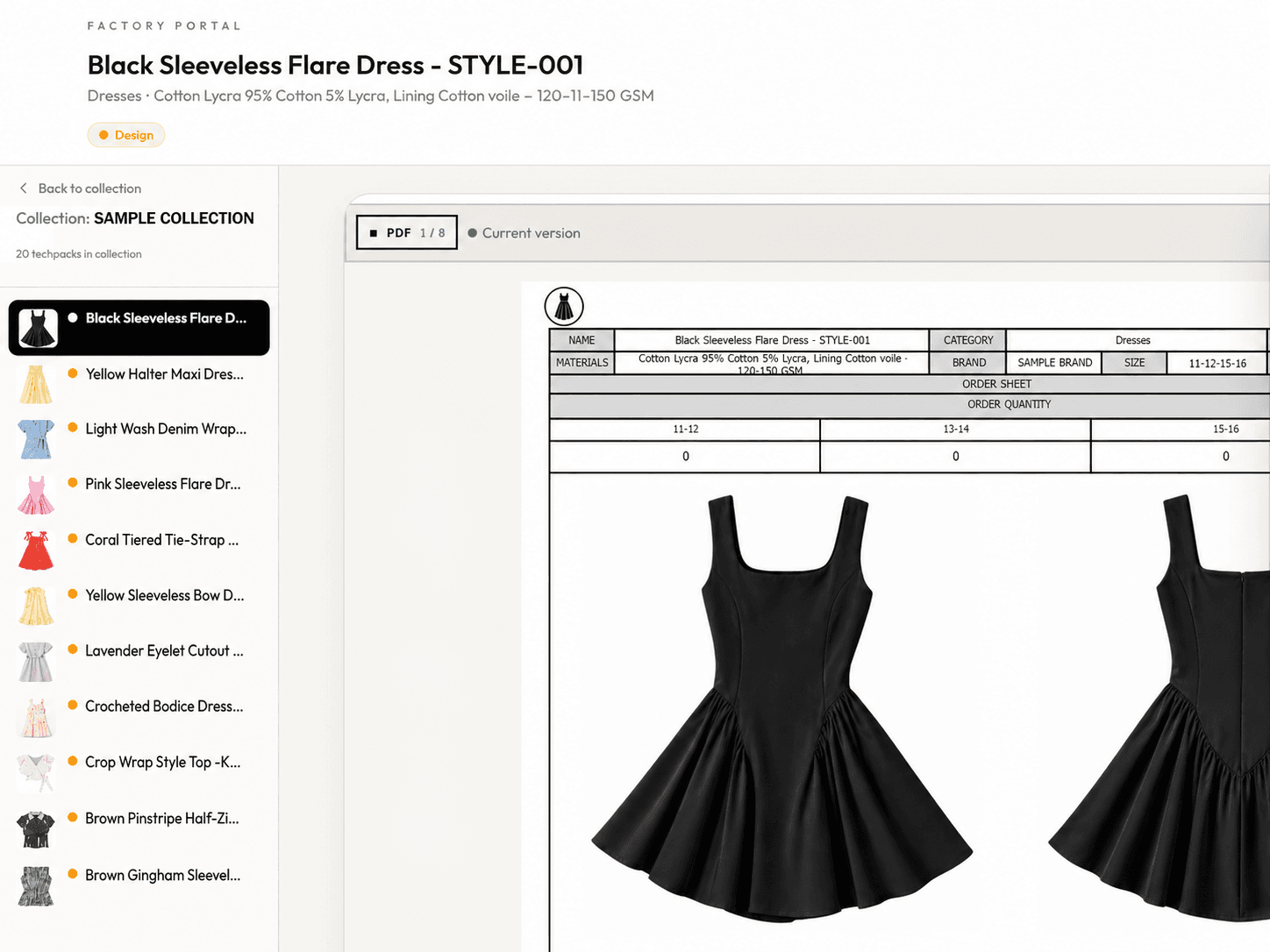
- Style number, version date, front and back technical flats
- Base-size measurements, points of measurement, and tolerances
- Bill of materials with fabric, trim, finish, label, and packaging details
- Construction callouts, artwork files, placement, and color references
- Clearly marked open decisions instead of silent placeholders
Document 02
RFQ cover sheet
- Quantity by style, color, and size—or the exact estimate to price
- Sales market, delivery destination, and requested timing
- Sample type, sample quantity, and approval expectations
- Testing, packaging, labeling, and freight assumptions
- Questions about MOQ, capacity, payment terms, and subcontracting
If you are still building the specification, start with our complete clothing tech-pack guide. AI Tech Packs can help create the first structured draft, but measurements, tolerances, materials, construction, artwork, and market-specific requirements still need human review before they control quotation or sampling.
A seven-step workflow from tech pack to comparable factory quotes
- 01
Freeze the quote version
Assign a style number, revision, and date. Remove duplicate files from the send folder and label unresolved choices. Every manufacturer should price the same revision.
- 02
Preflight the product definition
Check flats, measurements, tolerances, BOM rows, construction notes, artwork, labels, packaging, and reference images. Ask a technical reviewer to challenge ambiguity before a supplier has to guess.
- 03
Add the order context
State quantities by variant, the intended market, destination, target dates, sample route, and any target-cost context. These inputs affect feasibility and quote structure even when they do not belong inside the tech pack.
- 04
Build a capability-led shortlist
Filter for the garment category, material and construction processes, order scale, location, and capacity you actually need. A familiar category name alone does not prove the required machinery or experience.
- 05
Request assumptions and exclusions
Ask each supplier to identify what the quote includes, what remains provisional, which materials carry separate minimums, and what could change after development or testing.
- 06
Compare the whole commercial basis
Normalize sample fees, tooling, unit-price inclusions, packaging, testing, freight terms, payment terms, lead times, and surcharges. Do not rank factories on one unit-price cell.
- 07
Validate through sampling and approval
Verify the supplier independently, document sample comments against the current revision, and keep the approved sample, final tech pack, purchase order, and change log aligned before bulk production.
Partner resource
Visit Suplify ↗Where Suplify fits in the sourcing workflow
Suplify is an apparel-sourcing brokerage and directory rather than a clothing factory. Brands can search supplier profiles by product, country, and MOQ, contact suppliers, upload tech packs, and use an RFQ workflow. That makes it a practical discovery route once your brief is consistent enough to send.
You can find clothing manufacturers by product, country, and MOQ on Suplify, then evaluate each shortlist candidate against the same technical and commercial requirements. Its step-by-step tech-pack guide is also a useful second checklist for measurements, technical flats, artwork, BOM details, construction callouts, labels, and reference images.
Compare factory quotes on the same basis
Before ranking a shortlist, turn each reply into the same comparison grid. If a supplier leaves a cell blank, record it as unknown—not zero and not included.
Development
Sample types, sample fees, pattern or tooling charges, revision limits
Materials
Fabric and trim basis, minimums, surcharges, substitutions, testing
Unit price
Included operations, labels, packaging, inspection, and quoted quantity
Delivery
Production lead-time trigger, freight basis, destination, and handoff point
Commercial
Currency, payment schedule, quote validity, and cancellation assumptions
Operations
Capacity, subcontracting, communication owner, and approval checkpoints
Quote comparison is only one part of qualification. The OECD's garment and footwear due-diligence guidance describes an ongoing, risk-based process of identifying, preventing, mitigating, tracking, communicating, and remediating impacts. A marketplace profile or certificate image cannot perform that work for a brand.
Copy-and-paste apparel RFQ cover brief
Attach the current tech pack, then adapt this brief for the product and market. Delete fields that genuinely do not apply; do not leave them open to accidental interpretation.
Style / tech-pack version:
Product category:
Colorways and size range:
Quantity by style, color, and size:
Target sales market:
Delivery destination:
Requested sample type and quantity:
Requested quotation date:
Target production window:
Material or certification requirements:
Label, packaging, testing, and inspection needs:
Requested freight / trade-term basis:

Please list separately:
- sample, pattern, mold, screen, or tooling charges
- material and trim minimums or surcharges
- what the unit price includes and excludes
- payment terms and quote-validity period
- lead-time assumptions and production-capacity constraints
- any subcontracted processes
- every open question or specification assumption
Before bulk production, lock the approved truth
A quote is not a production approval. Keep the physical sample and the document set synchronized so the bulk order is not built from an older measurement chart, a superseded artwork file, or an assumption that changed during sampling.
- Issue one final tech-pack revision and archive superseded files.
- Record every approved sample comment and confirm which sample controls bulk.
- Match the purchase order, color and size breakdown, packaging, and delivery terms to the final quote.
- Confirm testing, inspection, traceability, and market-specific labeling responsibilities in writing.
- Keep change approvals tied to a date, owner, and affected document or sample.
Label and care instructions vary by market and product. For United States planning, review the current federal rules for textile fiber, business identity, and country-of-origin labeling and care labeling. Documenting intended label copy in a tech pack does not by itself establish legal compliance.
Frequently asked questions
What is an apparel RFQ?
An apparel request for quotation, or RFQ, is a consistent production brief sent to potential manufacturers. It combines the technical product definition with quantities, size and color splits, delivery context, sample expectations, and commercial questions so each supplier can quote against the same assumptions.
What should I send a clothing manufacturer for a quote?
Send one dated tech-pack version plus an RFQ cover sheet. Include the style, colorways, size range, quantity by variant, destination, target timing, sample request, packaging needs, and open questions. Ask the manufacturer to state exclusions and assumptions instead of silently filling gaps.
Do I need a complete tech pack before requesting a factory quote?
You can begin a feasibility conversation with references and estimated quantities, but a firm custom-development quote needs a much clearer specification. Mark unresolved details explicitly. Treat early pricing as provisional until measurements, materials, construction, artwork, labels, packaging, and testing needs are defined.
How do I compare quotes from clothing manufacturers?
Compare the same cost basis: sample and tooling fees, unit-price inclusions, material minimums and surcharges, packaging, testing, freight terms, payment terms, lead-time assumptions, and subcontracting. A lower unit price is not necessarily the lower landed or development cost when important items are excluded.
Does a sourcing directory replace supplier due diligence?
No. A directory can make discovery and outreach faster, but the brand still needs to verify company identity, capabilities, current certificates with their issuers, references when appropriate, subcontracting, sampling performance, product testing, and written approvals. Use listings as leads, not guarantees.
Can I send an AI-generated tech pack straight to a factory?
Treat an AI-generated tech pack as an editable production draft. A designer or technical reviewer should confirm measurements, tolerances, materials, construction, artwork, labels, packaging, and market-specific requirements before quotation or sampling. The approved version—not an unreviewed draft—should control the factory conversation.
Sources and further reading
- Suplify: How to Create a Tech Pack—Step-by-Step Guide — practical component checklist and sourcing context.
- OECD Due Diligence Guidance for Responsible Supply Chains in the Garment and Footwear Sector — risk-based supplier due-diligence framework.
- 16 CFR Part 303 and 16 CFR Part 423 — current U.S. textile and care-labeling rules.
Prepare the quote version
Build the technical draft before factories fill in the blanks.
Generate and edit the garment specification, review it with your production team, then use the RFQ cover brief above to request like-for-like quotes.